

” I am not what happened to me, I am what I choose to become. “
– Carl Jung
Across Palestinian communities, women continue to play a vital role in strengthening dialogue, leadership, and resilience. As the world marked International Women’s Day on 8 March , the importance of supporting women’s leadership and voices becomes even more evident, particularly in communities facing ongoing challenges.
Through initiatives such as Generation to Generation and Women of Dialogue , young Palestinian women are gaining tools to lead conversations, understand the impact of trauma on communities, and support healthier communication in times of uncertainty. These programs create spaces where women can strengthen their confidence, leadership skills, and ability to guide constructive dialogue within their communities.
At Holy Land Trust, there is a strong and growing focus on programs that support and empower women. By investing in women’s leadership, dialogue skills, and personal development, the organization aims to contribute to stronger, more resilient communities where women play an active role in shaping social change and fostering understanding.
These programs create safe learning spaces where participants can explore leadership, emotional awareness, and dialogue skills while learning from both experienced facilitators and one another. By connecting knowledge with lived experience, young women are encouraged to recognize their role as leaders within their families, communities, and professional environments.
Research in peacebuilding and community development shows that women’s leadership and participation in dialogue processes significantly contribute to stronger social cohesion and long-term community resilience.
Through training, reflection, and shared experiences, these initiatives aim to support a new generation of Palestinian women who are prepared to guide conversations with awareness, empathy, and confidence.
Understanding Trauma and Leading Dialogue with Awareness
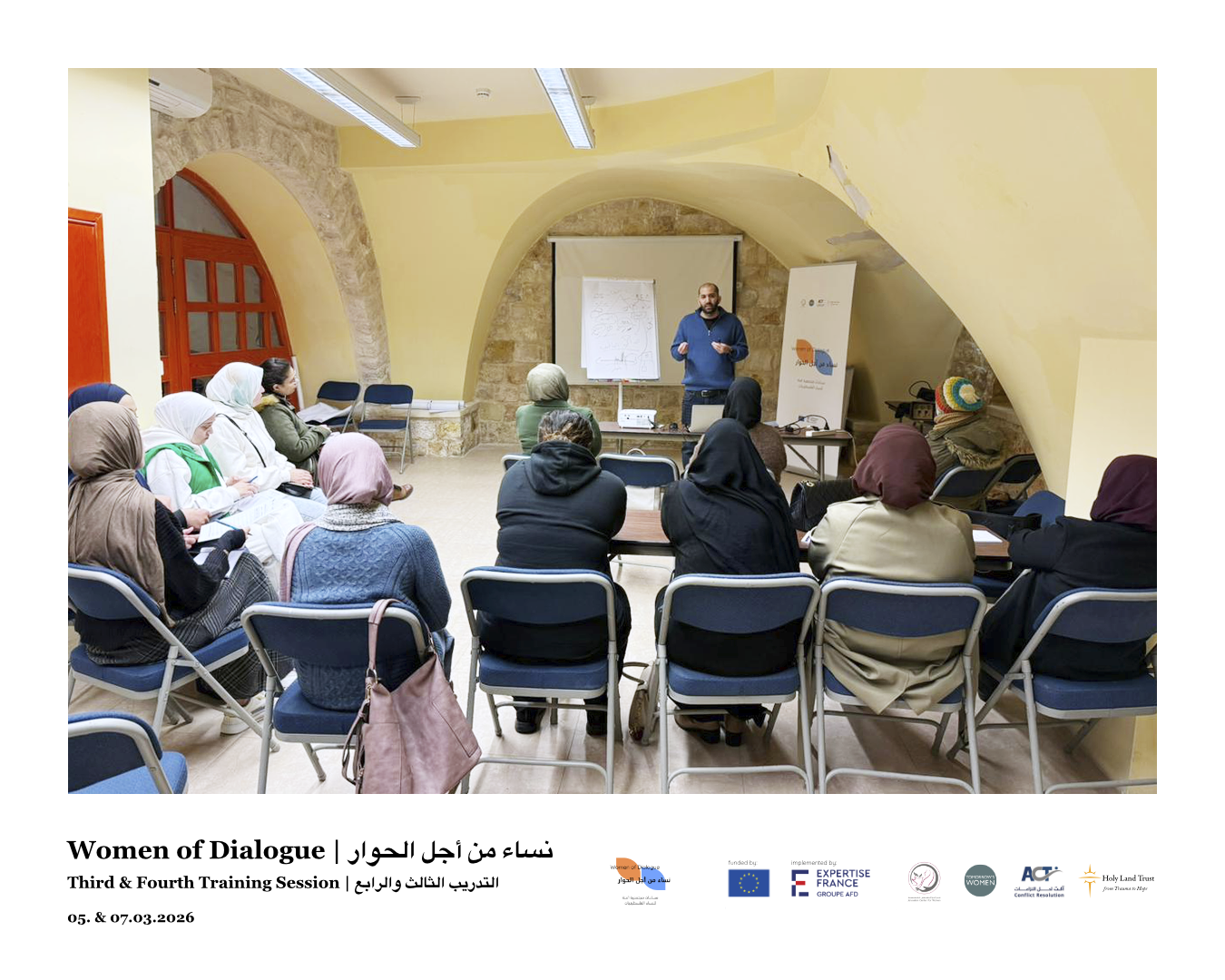
As part of the Women for Dialogue Project, Holy Land Trust organized the second training session focused on Trauma-Informed Care , facilitated by coach and trainer Issa Al-Hayek .
The training aimed to help participants understand how trauma affects individuals and communities, and how leaders can facilitate dialogue while maintaining emotional stability and healthy boundaries.
The first session took place online on 5 March 2026, with 20 participants joining from different locations. Due to strong interest from participants, a second session with 20 participants was organized face-to-face on 7 March 2026.
During the sessions, participants explored:
The meaning of trauma and how it affects behavior and communication
The concept of collective trauma within communities experiencing prolonged stress
The role of the nervous system in conflict and emotional reactions
Practical grounding techniques to remain calm during difficult conversations
Strategies for maintaining emotional boundaries and preventing burnout
The training emphasized that leaders are not expected to fix people’s trauma, but rather to create safe and respectful dialogue spaces where participants feel heard and understood.
Through practical exercises and reflection, participants learned simple grounding tools such as breathing techniques and awareness practices that help regulate emotional responses during conflict situations.
The session also addressed the importance of self-care and emotional boundaries, highlighting how community leaders who frequently listen to others’ experiences may face emotional fatigue or vicarious trauma if they do not protect their own well-being.
Holy Land Trust hosted a two-day online training on Friday and Saturday, 6–7 March 2026, titled “Self-Care and Professional Psychohygiene for Helpers Working in Ongoing Crisis Context,” led by trauma art therapist Karina Strasser-Neuhofer from the Austrian Institut für Trauma-Kunst-Therapie.
The 10-hour Training of Trainers brought together 25 artists, social workers, trauma practitioners, and educators from across Palestine, including Gaza, Bethlehem, Ramallah, Nablus, Qalqilia, Jenin, Jericho, and the 1948 areas. Participants explored practical tools for stress regulation, emotional protection, and sustaining resilience while supporting communities affected by prolonged crisis.
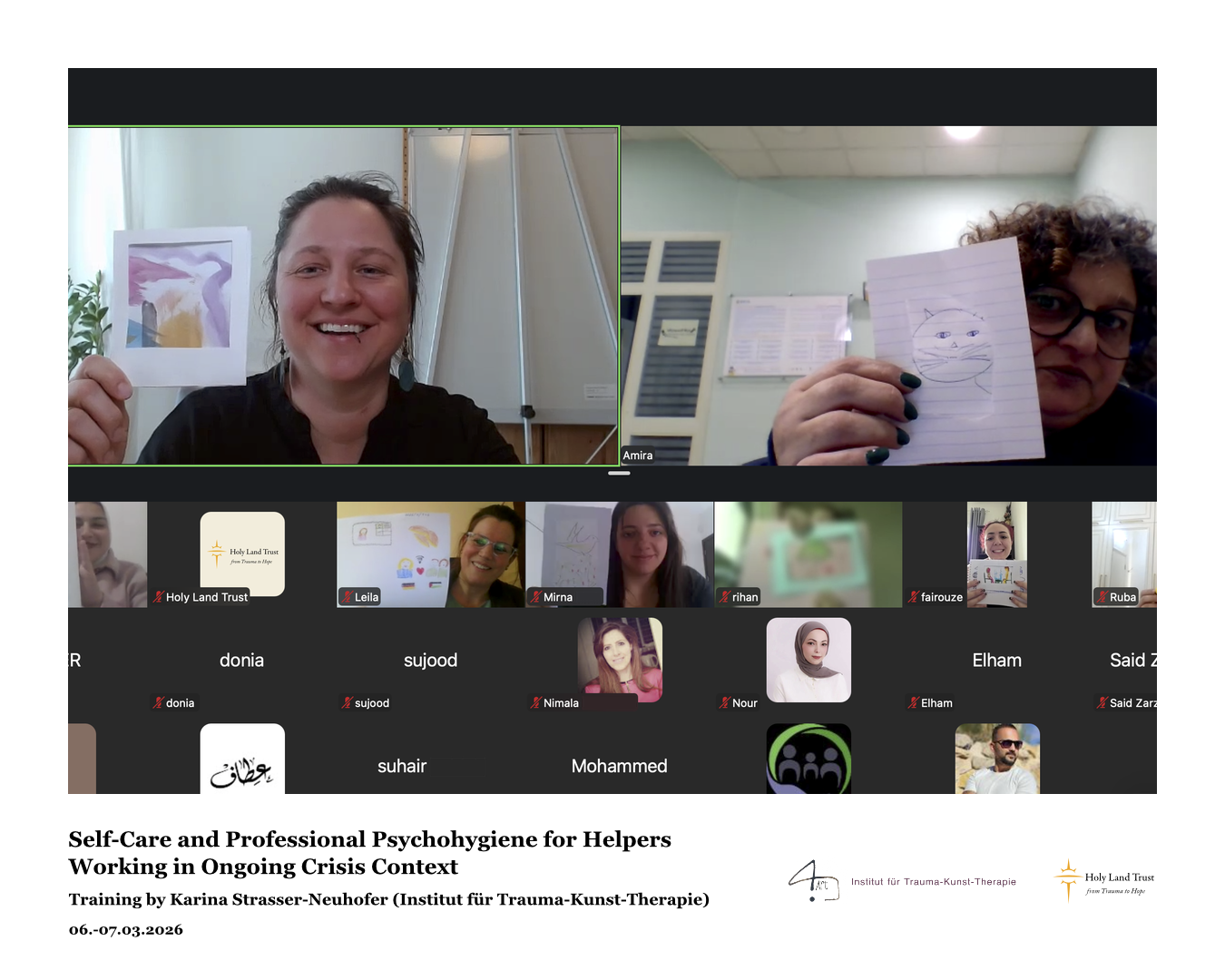
Through reflective dialogue, arts-based practices, and body-focused techniques, the training addressed challenges such as compassion fatigue and burnout, emphasizing that self-care is not a luxury but an essential part of professional practice for those working in crisis contexts.
Despite taking place online, the workshop created a meaningful space for connection, reflection, and peer support among professionals living and working through similar realities.
This training forms part of Holy Land Trust’s broader efforts to develop Art-Based Trauma-Sensitive Interventions for the Palestinian Context , strengthening the wellbeing of those who support their communities and reinforcing the spirit of Sumud — steadfast resilience.
S trengthening the Leadership Role of Young Women
As part of the Generation to Generation project, Holy Land Trust organized a three-hour online leadership session facilitated by Mirna Sakhleh , with the participation of 16 young women.
The session focused on exploring different dimensions of leadership and encouraging participants to reflect on their own leadership potential within their communities.
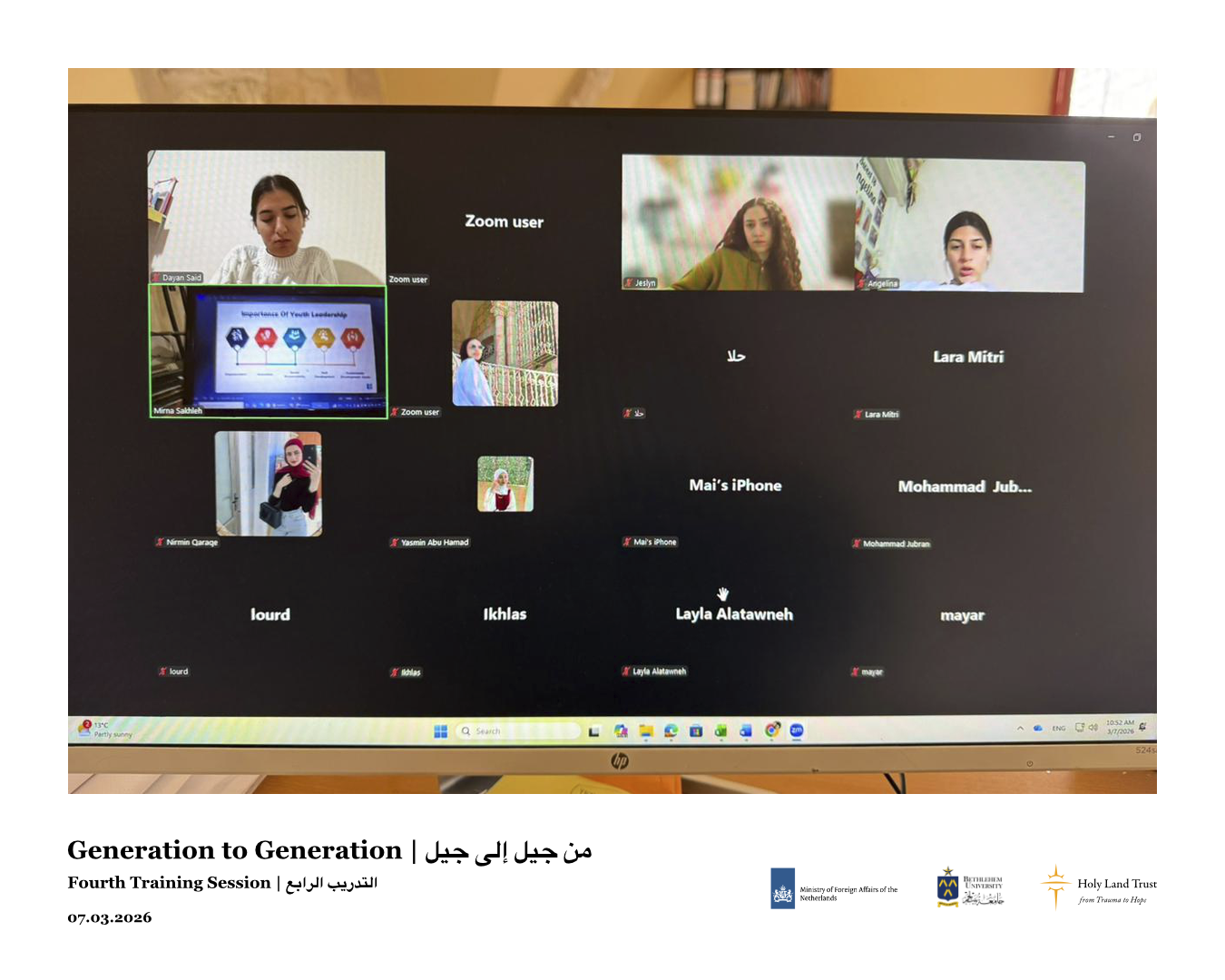
Throughout the session, participants discussed:
The meaning of leadership in social and community contexts
The role of women leaders in creating positive change
The importance of confidence, responsibility, and self-awareness in leadership
Challenges young women may face when stepping into leadership roles
Participants engaged in interactive discussions and exercises that encouraged them to reflect on their personal experiences and identify the strengths they bring to their communities.
The session also highlighted how learning from the experiences of older generations can inspire young women to continue building pathways for dialogue, participation, and social engagement.

Programs like Women of Dialogue and Generation to Generation continue to provide important spaces where Palestinian women can develop leadership skills, share experiences, and strengthen their ability to guide conversations within their communities.
In times marked by uncertainty and emotional pressure, these spaces become essential for building resilience and supporting constructive dialogue.
Your support helps Holy Land Trust continue providing training, mentorship, and safe environments where women leaders can grow and contribute to stronger and more connected communities.
Every training we organize is more than a workshop. It is a space where women discover their voice, support one another, and learn how to transform difficult experiences into strength for their communities.
Said Durzi Zarzar,
TRAVEL & ENCOUNTER PROGRAM MANAGER